How Changing your Name Affects your Numerology Readings

nameOne of the wisest things any man can today is to request a numerology reading to figure out personality traits and future occurrences.

However, what most people are not aware of is the fact that numerology has been around since the 6th century BC when Pythagoras first found the patterns in everyday numbers.

Today, many people believe that changing their names can have major impacts on their numerology readings and thus influence their futures significantly.

Changing your name for numerology purposes that are solely based around changing your future and your personality traits is something that is open for debate.

Many people are against doing this because they believe that you are born with personality traits that cannot be modified by simply altering your birth name.  Some numerologists do believe that changing your name will not necessarily alter your personality.

The expression and destiny numbers are directly related to your name and the results from numerology readings will affect your life paths.

When you get your numerology readings performed according to your name, you will be given specific years that major changes and obstacles could occur. Obviously, if it were as simple as changing your name to avoid major life changes, everyone would do it.

Although changing your name simply for numerology purposes is not recommended, many of us will go by different names or alter egos during our lifetimes. These different names can definitely have an impact on your numerology readings and they don’t necessarily need to be legal names in order to make them fit into your numerology readings.

Some of the names that can affect your numerology chart include nicknames that you may go by, pen names that you may use as a writer, married names that you get after getting married and even names that you may use when you don’t want to use your real name. These names can all be accounted for when having your destiny or expression numerology readings read.

Using all of your alternative names can allow you to understand why you react the way that you do in certain circumstances. Most people will behave differently according to the people they are with and depending on where they are. If you use a nickname when you’re with your friends, you will probably act differently than when you use your real name with your business partners.

Defining the numerology readings for all of your used names and nicknames will allow you to have a much more profound understanding of the ways that you react in specific situations. Being able to figure out different emotions, personalities and traits that you have according to the different names that you use can come in handy.

However, since all numbers in numerology have a balance of both positive and negative effects; changing your name doesn’t necessarily mean that you will experience only the positive sides of the new traits. You could very easily change your name for a new numerology chart and end up inheriting the negative effects of your new numbers.

coaching3

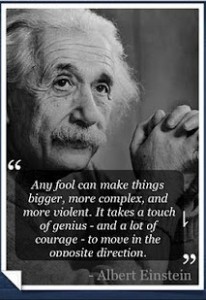
10 Greatest Lessons From Einstein

albert-einstein-quotes-pic1-206x30010 Greatest Lessons From Einstein
Source: Become Second To None (The Brain Guide Series)

Albert Einstein was an immortal of sciencethat made noteworthy changes and contributions in the 20th century. He was an inspiration for the remarkable scientists subsequent to him for his brilliant discoveries.

Einstein was prominent for his works in theoretical physics, a great philosopher of science for his simplicity and theory choice, realism and separability, etc. and an author of several books. Above all, Einstein was prominent as the father of modern physics.

There were four works of Einstein that substantially contributed to the foundation of modern physics. These works relate to photoelectric effect, Brownian motion, special relativity and matter – energy equivalence. The four areas of focus were the justification for the discovery and explanation of quantum theory, atomic theory and concepts on matter, space and time.

Einstein received the Nobel Prize in Physics in 1921 “for his services to Theoretical Physics, and especially for his discovery of the law of the photoelectric effect.”

Aside from his triumphant academic career, Einstein was a distinguished teacher not only to the confines of the classroom, but as well as to the globe. His works were indeed immortal and superior from his lessons on the subject of life. For that superiority, everybody ought to remember at least 10 quotes from him, which brings forth valuable lessons about life.

Lesson 1: Cultivate a Curious Mind

“I have no special talent. I am only passionately curious.” Do not hold back curiosity. It has a reason for its existence. Keep a questioning mind.

Lesson 2: The Worth of Perseverance is Intangible

“It’s not that I’m so smart; it’s just that I stay with problems longer.” The price of perseverance is beyond the corporeal things. It cannot be measured. It cannot be sold. It has no price.

Lesson 3: Devote Attention To One Thing At A Time

“Any man who can drive safely while kissing a pretty girl is simply not giving the kiss the attention it deserves.” Do not do several tasks at once. It is in doing one task at a time that excellence is achieved.

Lesson 4: Give Weight to Imagination

“Imagination is everything. It is the preview of life’s coming attractions. Imagination is more important than knowledge.” Imagination is cheaper than free. It is in imagination that one recognizes the knack he has.

Lesson 5: Mistakes Are Inevitable

“A person who never made a mistake never tried anything new.” More often than not, mistakes are stepping stones to new discoveries. It is part and parcel of living.

Lesson 6: The Future is Not Ours to See

“I never think of the future – it comes soon enough.” The future is a result of the things we do today. Thinking what lies beforehand is not a bad scheme, but most of the time the present is being neglected.

Lesson 7: Value is Superior to Success

“Strive not to be a success, but rather to be of value.” Success is a goal worth striving for. However, creating value has an enduring effect for people to remember.

Lesson 8: Change Triggers Another Result

The definition of insanity is doing the same thing over and over and expecting different results’. Different results occur when you change the way you do things. Only unwise people will expect a different result from doing the same thing over and over again. Different results will only be possible by way change.

Lesson 9: Information is not knowledge. The only source of knowledge is experience

Lesson 10: Understand the Basics

“You have to learn the rules of the game. And then you have to play better than anyone else.”

box1-264x300If you find the information presented above useful…

…you will find more useful killer information at “Become Second To None“… a unique brain power guide that’s guaranteed to improve your IQ and brain power!

3 Buddhist Beliefs That Will Rock Your World (And Make You Much Happier!)

BuddhistBy: Megan Bruneau / Source: Mind Body Green

You don’t have to practice yoga or follow an Ayurvedic diet to benefit from Buddhist ideas (but if you do, more power to you).

So whether or not you think about balancing your dosha, here are three powerful elements of Buddhist philosophy, “The Noble Truths,” and how you can incorporate them into every day.

They might just change your life…

1. Dukkha: Life is painful and causes suffering.

Many people might say that Buddhism is pessimistic or negative. This is a common result of learning that one of the Noble Truths is translated as “Life is suffering.”

But there’s more to this statement. It’s not just telling us, “Life is tough, so deal with it.” So what is it telling us?

We actually can create more suffering in our lives by trying to avoid or suppress difficult emotions.

Yes, our lives are inevitably punctuated with various unpleasant feelings: loss, sadness, fatigue, boredom, anxiety appear and reappear during our lives.

But attaching or clinging to particular expectations, material items, and states of being is often a cause for acute frustration, disappointment, and other forms of pain.

So rather than fear our suffering or seek an ultimate resolution to it (and become frustrated by our lack of finding one), we can learn simply to recognize our suffering.

How we can use this belief every day: Try not to buy into the idea that you’re broken. Expect that death, aging, sickness, suffering, and loss are part of life.

Practice acceptance in the face of strife. Stop attaching to the idea that life should be easy and pain free, both emotionally and physically. This is a misconception made popular by the fashion, beauty, and pharmaceutical industries.

Illness, heartbreak, loss, disappointment, and frustration are parts of life that can be mitigated by practicing “non-attachment.” Try to embrace imperfection, to let go of this belief that life should be a certain way. Open your heart to uncertainty.

2. Anitya: Life is in constant flux.

Anitya or “impermanence” means that life as we know it is in constant flux. We can never access the moment that just passed, nor can we ever replicate it.

As each day passes, our cells are different, our thoughts develop, the temperature and air quality shifts. Everything around us is different. Always.

When we are feeling especially uncomfortable, the concept of impermanence can be, paradoxically, comforting. In other words: if nothing is permanent, we know our pain will pass.

But when we are experiencing joy, the idea of impermanence can be incredibly fear-inducing.

If we accept the idea of impermanence at face-value, it can be incredibly liberating. In the West, about 100 years after the Buddha expressed this idea, Greek philosopher Heraclitus mirrored the belief when he famously said, “You can never step in the same river twice.” All we have is the present moment.

How we can use it in our everyday lives: Celebrate the idea of change. Accept that everything is constantly changing. It’s kind of amazing, when you just think about it!

And even when the idea of impermanence might feel scary, it helps us appreciate everything we are experiencing in the present: our relationships, body, mood, health, the weather, our favorite shoes, our jobs, our youth, our minds.

So let’s savor those moments we do enjoy and know that the ones we don’t enjoy will pass.

3. Anatma: The self is always changing.

When I ask clients what they want to get out of therapy, they commonly answer, “I want to find myself.” Our culture has led us to believe there’s a concrete, constant “self” tucked away somewhere in us.

Is it between our heart and liver? Or somewhere unknown in our brain? Who knows!

Buddhism, however, assumes there is no fixed, stable “self.” In line with Anitya (impermanence), our cells, memories, thoughts, and personal narratives — all of the “matter” that ultimately comprises our identities — change over time.

Sure, we all have personalities (though they can change over time). We have names, and jobs, and other titles that we use to identify ourselves, to feel a sense of “self.”

But the idea of a constant self is yet another story our culture has told us. It is a story we can change, and thereby accept the idea that we ourselves can change — at any time, in any place.

As Thich Nhat Hanh says, “Thanks to impermanence, anything is possible.”

How we can use it in our everyday life: Instead of focusing on “finding ourselves,” we ought to focus on creating the self we wish to be at every moment.

It’s possible for us to be, and feel, different today than we were and felt yesterday. Being depressed today doesn’t mean we’ll be depressed forever. We can forgive others. We can forgive ourselves.

Once we let go of our attachment to the idea of the constant “self,” we can rest more comfortably with the constant change present in all of life. In each new moment, we ourselves are new.


Want To Find Your Dharma? Ask Yourself These 7 Questions

dharmaBy: David G. Arenson / Source: Mind Body Green

The Buddhist concept of Dharma has a central philosophy that all is whole and complete as it is. There is no accident in the entire universe.

Even your reading this right now is not accidental, nor my writing it. We are together in this grand interplay of cosmic elements.

Most of the daily challenges we experience as human beings originate from a lack of understanding. Dharma is the way out of this.

The way to cultivate refinement of the mind and uplift the human experience from ignorance and suffering, is to practice Dharma.

So what is this cryptic and mysterious notion of Dharma and is there a way to decode it for modern consumption?

Dharma is a broad concept with many understandings and definitions, very much like the term coined by Chinese philosophy as Tao.

Its translation as “the path” or “the way”, Tao and Dharma support the natural order of the universe and those who are in harmony with it.

Dharma could also be described as the nature of “what is” and in Buddhism, refers to the practice of following the Buddha’s teachings. The diligent observance and practice of these teachings, is seen as the way to enlightenment.

One could argue that Dharma is a truth, a teaching, a practice and enlightenment itself.

Living in Dharma means living ones’ true purpose and personality, and expressing it in the world. By living quietly in fear, limitation, or otherwise, we are denying the world our one-of-a-kind gifts.

Living from the ego denies the full expression of our talents for the benefit of others. The purpose of Dharma is to allow the everyone in the world to evolve to their full potential.

“We know we are in Dharma when we cannot think of anything else we would rather be doing with our life.” —David Simon

How does one relate to the seemingly mystical and intangible elements to finding one’s Dharma?

For the whole symphony of the universe to vibrate at its most refined and poetic, it requires all individual instruments (that’s us!) to play their part. Thus, one thing is essential for the greater good — each person must follow their authentic path.

If every person sang their song, the symphony would be sublime, whole and complete.

I am not here by mistake. And neither are you! I am serving the whole, as are you. The Dharma needs all instruments to express themselves.

And then the whole universe supports us when we act according to our true nature, our calling and our purpose — our whole reason for being.

Living a meaningful life requires that we live in Dharma, in service of the whole of creation. Dharma is an active opening, a mission, a doorway, a purpose, a destiny, but also a passive process of surrender.

So how do you find YOUR Dharma? Here are seven questions to meditate on:

  1. Do you have any idea what your Dharma is?
  2. Have you found it yet?
  3. Where have you looked?
  4. How would you live differently if you knew your days were numbered?
  5. Which people do you admire most and why?
  6. What are your fondest memories?
  7. What were you doing when you recall having the most fun?

“You are born with a character, it is given, a gift as the old stories say, from the guardians upon your birth.” —James Hillman