 By: Flame Horse / Source: List Verse
Biblia Sacra – the Holy Bible – is the most widely read book in the world. It is a source of inspiration to many and – more curiously – a source of divination and secret codes.
This list looks at ten significant numbers in the Bible – numbers that pop up time and again. Many people take this with a grain of salt but many others consider it to be very important and believe that the study of these numbers can unlock knowledge of the future. Interesting.
10. ONE
No surprise, but 1 is obviously used throughout the Bible to indicate one thing only, God Himself. “The one true God.” The number 1 Commandment is “Thou shalt have no other gods besides me.” Deuteronomy 6:4: “Hear, O Israel: the Lord our God, the Lord is one.”
This was to remind the Jews of the time not to worship multiple gods like all those civilizations around them. 1 is enough. Numerology seems to be more than just coincidence when we consider the chapter and verse, 6:4. 6 plus 4 equals 10 (see #5).
Just as God is 1, so Satan is 1 single entity by himself until the last book. Whenever someone is alone in the wilderness, whether it is Moses, or Elijah, or Jesus, they are not really alone, but are, in fact, never closer to the one, true God than at that moment.
Jesus is abandoned in the end and left all alone, and he says as much to his Disciples, then reminds them that he will not be alone, but the Father will be with him.
9. TWENTY-TWO
The Bible employs 22 in a more arithmetical manner than most numbers. Consider the perfect shape to be a circle. 22 divided by 7 is a good approximation of pi, which is the ratio of a circle’s circumference to its diameter.
From the first epistle, Romans, to the end is 22 books. This ties in with what is known as the Canon Wheel. The Bible may be divided into three sections of 22 books each (though only in Protestant Bibles as they removed seven books from their Canon).
The first is comprised of Genesis to the Song of Solomon, the second from Isaiah to Acts, and the third from Romans to Revelation. The first may be thought of as representative of the Father, the second of the Son, and the third of the Spirit.
There are 22 letters in the Hebrew alphabet. Revelation ends the whole Bible on a 22nd chapter. If the patriarchs’ ages, as given in the Bible, are added up, then Abraham’s birth year was 2167 BC. From then to the death year of Jesus, 33 AD, is 2200 years precisely.
Jesus quotes the opening of Psalm 22 while in agony on the cross, “My God, my God, why hast thou forsaken me?” The chronology of men from Adam to Jacob totals 22 names. Jeroboam reigned for 22 years.
8. FORTY
The Bible uses 40 to denote completion or fulfillment. It is used 146 times throughout both Testaments. It is the traditional Hebrew number for the duration of a trial of any kind, when times are hard and a person’s faith is tested.
The Israelites slaved in hard bondage under the Egyptian pharaohs for 400 years, 10 times 40. God forced them to wander in the Wilderness of Sin, throughout the Sinai Peninsula, for 40 years as punishment for their “stiff-necked unbelief.”
“Sin,” here, does not denote sinfulness, but the Hebrew word for the Sumerian moon god, from which “Sinai” is derived. Moses was 40 years times 3 when he died, at 120.
Moses was 40 days on Mount Sinai receiving God’s Law, another 40 days on the mountain after the golden calf sin. Elijah, some 300 years later, spent 40 days on the same mountain worshiping God.
There are tons of references to “40 days and 40 nights” throughout the Bible. The most notable are the 40 days and nights of rainfall that caused the Flood of Noah.
During this time, the whole world flooded to a depth of some 15 feet above the tallest mountains. It took 375 days for the water to recede.
Jesus fasted for 40 days in the wilderness before being tempted by Satan. Jesus remained on Earth for 40 days after his Resurrection, appearing to the Apostles and teaching them, before ascending to Heaven.
At the time of his Ascension, there were about 120 Christians on Earth, or 40 times 3.
It was about 40 years from Jesus’ Ascension to the destruction of Jerusalem, in 70 AD, by the Romans.
In the original Koine Greek, as recorded in the Codices Sinaiticus and Vaticanus, the oldest complete manuscripts of the New Testament (c. 200-250 AD), Jesus utters the word “fulfill” in some variation or other, precisely 40 times throughout the Gospels.
7. TWELVE
12 is used in a similar way to 3, 10, and 40. It indicates a kind of totality.
The most obvious example of 12 are the 12 tribes of Israel, mentioned many times throughout the Bible. Revelation incorporates multiple uses of 12.
After the Tribulation begins, Christians will have already been Raptured to Heaven to spare them the horrors. 144,000 people, 12,000 from each tribe of Israel, will be converted to Christianity and die as martyrs under the reign of the Antichrist.
The New Jerusalem, the city of Heaven, is described as having walls 144 cubits thick, symbolic of the 12 tribes and the 12 Apostles.
The foundations of the walls are made of 12 precious stones. The city is foursquare, with walls 12,000 stadia, or furlongs, long, wide, and high. Stadia and furlongs are not the same length, but are close.
The former equates to about 1,400 miles, the latter to about 1,500 miles. There are 3 gates in each side, for 12 total. These are made of single pearls, giving us the phrase “pearly gates.” Inside, the Tree of Life yields 12 different kinds of fruits.
Daniel is also concerned with the time of the end, and Daniel has 12 chapters. Daniel 12:12 states, “Blessed is the one who waits for and reaches the end of the 1,335 days.” 1 plus 3 plus 3 plus 5 equals 12.
When Jesus feeds the 5,000, his Disciples pick up 12 basketfuls of leftovers afterward.
6. FOUR
12 has much in common with 4, 3, and 10. They all indicate completion of some sort.
Of the 12 tribes of Israel, Jesus’ lineage is traced back to Judah, the fourth tribe. There are 4 major writing prophets, Isaiah, Jeremiah, Ezekiel, and Daniel.
There are 12 minor writing prophets (see #7), or 4 times 3: thus three different ways to indicate the totality of the Old Testament’s prophecies.
There are 4 horsemen of the Apocalypse.
There are 4 angels standing ready at the 4 corners of Earth.There are 4 Gospels, 4 living beasts in Ezekiel, Daniel, and Revelation. T
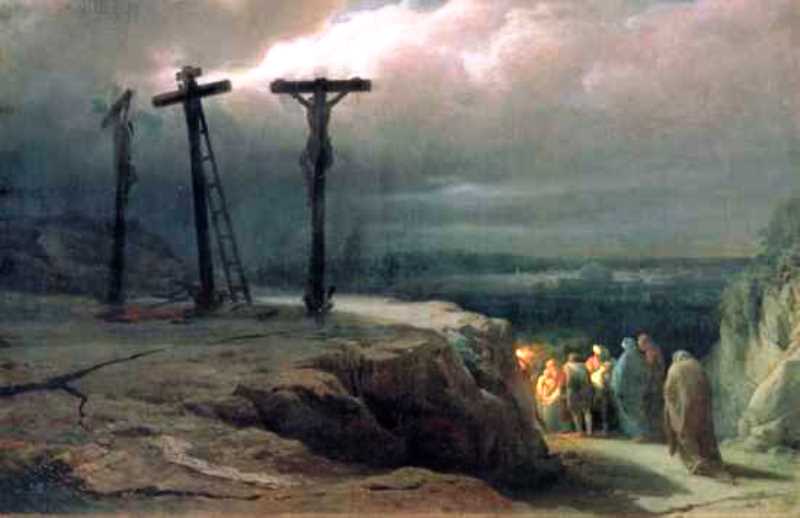
here are 4 points of the Cross, which is more significant than you might think, since the typical cross of the time was either a single, vertical pole, called a crux simplex, or a Tau cross, named after the capital Greek T. The lowercase “t” was unnecessary unless something needed to be added above the head of the condemned, and such placards were only needed for the executions of celebrated people.
5. TEN
The instances in which 10 shows up are too numerous to list. Aside from the Ten Commandments, there are a total of 603 other commandments, for a total of 613. 6 plus 1 plus 3 equals 10. 10 is a psychologically satisfying number.
We don’t care as much for top 9 lists as we do for top 10 lists. We have 10 appendages on the ends of our hands and feet. So it is natural for 10 to be an important number throughout the Bible. It indicates completion, just as 4, 12, 3, and 40.
Noah was the 10th patriarch before the Flood.
John 3:16 is the thesis of the entire Bible. It is the mirror image of the number of laws in the Old Testament, and thus, its digits add up to 10. God promises not to destroy Sodom and Gomorrah if only 10 righteous people can be found in them.
Jesus performed a total of 37 miracles across the Gospels. 3 plus 7 equals 10. In the original Greek, he says some variation of the word “fulfill” 10 times in each Gospel. He quotes Deuteronomy more than any other book of the Old Testament, 46 times. 4 plus 6 equals 10.
4. SIX
The Bible uses the number 6 to indicate imperfection. The work week is 6 days long, but it is missing something until God decides to set aside another day, on which no work is to be done, but rest must be taken in honor of God resting from his great work.
The most well known number in the Bible is, of course, 666, which symbolizes the Unholy Trinity. Satan is alone (see #10) until the events of the Revelation.
He is the antithesis of the Holy Spirit, not God, for it is Satan’s spirit that control the two beasts. One is the Antichrist, who is the antithesis of God, and the other is the False Prophet, the antithesis of Jesus.
As each of these entities is imperfect, it is represented by the number 6, whereas the Holy Trinity is 777. It is interesting to note there are 66 books in the King James Bible, as though it may be incomplete.
3. THREE
3 is the number of the Trinity, of course, and thus, indicates a wholeness, but it also seems to indicate an inner sanctity. Of Jesus’ 12 Apostles, he loves 3 of them more than the rest.
They are Peter, and brothers John and James. It is understood that because they had strong faith in Jesus, he liked them more than the other 9.
They were allowed to witness his Transfiguration, another example of 3: he suddenly stood talking in bright white clothing with Moses and Elijah.
Samuel is called by the Lord 3 times before he realizes it and answers. Satan tempts Jesus 3 times before giving up. It is on the third day of creation that Earth is made.
The placard on the Cross is written in 3 languages. Jesus raised 3 people from the dead, Lazarus, a widow’s son, and the daughter of a man named Jairus.
Though the Bible does not say how many lashes Jesus suffered, the Law of Moses required 40 minus 1. 40 was deemed sufficient to kill a man (see #8), so 1 lash was subtracted.
3 plus 9 equals 12 (see #7); 3 times 9 equals 27 (see next entry). 3 squared is 9. 39 is also the number of books in the Old Testament.
There are 3 angels named in the Bible: Michael, Gabriel, and Lucifer. Jesus was about 33 when he died. He was set up on the cross at the third hour of the day, and lasted until the ninth.
He rose from the dead on the third day, just as Jonah was in the belly of a great fish 3 days. Jesus fell under the cross 3 times on the Via Dolorosa.
2. SEVEN
The Bible uses 7 to indicate perfection, and 7 and 14 are inseparable throughout it. God is said in Revelation to have 7 Spirits, depicted as 7 lamp stands. The 7 candelabra (menorah) set on the Tabernacle in Exodus and Deuteronomy are an homage to God’s “sevenfold Spirit.”
Noah led the clean animals into the ark in sets of 7 pairs for each species. The unclean animals were saved to the tune of one pair each. Joshua led the Israelites, with the Ark, 7 times around Jericho.
“John the Baptist” is how Matthew first refers to the man generally understood to be the last of the Old Testament prophets, who preaches according to the Law of Moses and predicts the coming of the Messiah. “John the Baptist” has 14 letters, which is twice 7. “Jesus the Christ” has 14 letters.
The 4 living beasts, which Ezekiel identifies as Cherubim, are mentioned 3 times in the Bible (see #6). 4 plus 3 equals 7. Ezekiels sees 4 wings and 4 faces on each beast. 4 times 4 times 4 equals 64, and the beasts are introduced in Revelation at chapter 4, verse 6, 64 reversed. Revelation depicts the beasts as having 6 wings each. 6 plus 4 equals 10 (see #5).
Revelation is written and sent to the 7 major churches of Asia minor. The Tribulation will last 7 years.
When Jesus feeds the 4,000, his Disciples pick up 7 basketfuls afterward. He feeds this multitude with 7 loaves of bread, plus some fish. He feeds the 5,000 with 5 loaves and 2 fish. Jesus teaches with a total of 37 parables.
Although it may seem quite contrived, it is not to consider that Jesus is popularly thought to have suffered 5 wounds on the Cross: two nails in his hands, one in his feet, the crown of thorns, and the spear in his side; whereas, he can be more properly thought of as suffering 7 wounds: both hands, the thorns, the spear, the flogging itself, and both feet.
The feet were nailed apart to the sides of the cross, through the heel bones, since the bones would support the weight of the victim on the nails. A single nail through the top of the feet will not.
There are 31,102 verses in the King James Bible. 3 plus 1 plus 1 plus 2 equals 7. There are not 777,777 words in the King James Bible (wouldn’t that be astounding?), but it’s close, at 774,746. There are three 7s, and the rest adds up to 14. 774 minus 746 equals 28, which is 7 times 4.
What verse sits precisely at the middle of the Bible? Since there is an even number, there are two middle verses. They are Psalm 103: 1 and 2, the same digits as in the total number of verses.
“Bless the Lord, O my soul: and all that is within me, bless his holy name. Bless the Lord, O my soul, and forget not all his benefits.” These two verses have a total of 28 words, 7 times 4.
The precise center of this passage is the four-word phrase, “Bless his holy name.” Excising this leaves 24 words, which is twice 12 (see #7). The two verses effectively mirror each other.
The first sentence of the first verse of the Old Testament, in the original Hebrew, has 7 words. The first sentence of the first verse of the Gospel of Mark, which was the first to be written, has 7 words. There are 7,957 verses in the New Testament. 7 plus 9 plus 5 plus 7 equals 28, or four 7s.
1. TWENTY-ONE
Isaiah’s prophecy of the coming of the Messiah becomes explicit at Chapter 7, verse 14, “Behold a virgin shall conceive and bear a son.” 14 is twice 7, and the two add up to 21.
There are 14 generations from Abraham to david, 14 from David to the Baylonian exile of the Jews, and 14 from there to Jesus. These generations are divined thrice, thus 3 sets of 14, or 42, twice 21.
There are 21 chapters in the Gospel of John. There are three epistles of John, with 5, 1, and 1 chapters respectively. 5 plus 1 plus 1 equals 7, times 3 epistles equals 21.
In the Revelation, believed by many to have been written by the same John, there are 3 dispensations of God’s wrath, first 7 seals, then 7 trumpets, then 7 bowls of wrath. 7 times 3 equals 21.
“God” or “Lord” appear in the King James Bible a total of 10,875 times. 1 plus 8 plus 7 plus 5 equals 21, or 7 times 3.
There are 22 chapters in Revelation (see # 9), and the last chapter contains no violence of any kind. It is the absolute final aftermath of everything, depicting solely the perfection of life in the New Jerusalem, Heaven on Earth, with God and Jesus reigning on thrones in the center of the city, where death and pain no longer, and never again, exist.
Thus, the 21 chapters preceding this can be seen as the totality of God’s judgment against the wicked, and punishment and destruction of evil, followed by the number 1, a single chapter all on its own, “a new beginning.”
The 22nd chapter ends on the 21st verse, “The grace of our Lord Jesus Christ be with you all. Amen.” 2 plus 2 plus 2 plus 1 equals 7 (see #2).
+ FORTY-SIX
Just for fun, there is a theory that William Shakespeare helped translate parts of the King James Bible. It is not known if he was fluent in Hebrew, but his plays showcase various Latin, Greek, and French phrases.
The Baconian Theory that Shakespeare did not actually write his works centers on the premise that he is known to have had only a grammar school education, and would not have been so multilingual, or philosophical. This is, of course, a patently false analogy.
Either way, Shakespeare’s absence from the lists of official translators and scholars seems glaring in light of his literary stature and the fact that the King James
Bible was published in 1611, at the very pinnacle of his genius. Hamlet was published some time around 1602-03, King Lear in 1605-06, Macbeth in 1606, Cymbeline and The Tempest in 1610-1611.
In 1610, when the King James translation teams were working on the Hebrew, Aramaic, and Greek source texts, Shakespeare was 46 years old. It is believed he personally translated Psalm 46, perhaps at the behest of King James or the translators, out of respect for Shakespeare’s poetic brilliance.
The 46th word of Psalm 46 is “shake.” The 47th word up from the bottom is “spear,” possibly indicating that Shakespeare would turn 47 by the time the King James Bible was finished.