The Top 5 Regrets of the Dying

images (1)By: Susie Steiner / Source: Business Insider
There was no mention of more sex or bungee jumps.

A palliative nurse who has counselled the dying in their last days has revealed the most common regrets we have at the end of our lives. And among the top, from men in particular, is “I wish I hadn’t worked so hard.”

Bronnie Ware is an Australian nurse who spent several years working in palliative care, caring for patients in the last 12 weeks of their lives. She recorded their dying epiphanies in a blog called Inspiration and Chai, which gathered so much attention that she put her observations into a book called The Top Five Regrets of the Dying.

Ware writes of the phenomenal clarity of vision that people gain at the end of their lives, and how we might learn from their wisdom. “When questioned about any regrets they had or anything they would do differently,” she says, “common themes surfaced again and again.”

Here are the top five regrets of the dying, as witnessed by Ware:

1. I wish I’d had the courage to live a life true to myself, not the life others expected of me.

“This was the most common regret of all. When people realise that their life is almost over and look back clearly on it, it is easy to see how many dreams have gone unfulfilled. Most people had not honoured even a half of their dreams and had to die knowing that it was due to choices they had made, or not made. Health brings a freedom very few realise, until they no longer have it.”

2. I wish I hadn’t worked so hard.

“This came from every male patient that I nursed. They missed their children’s youth and their partner’s companionship. Women also spoke of this regret, but as most were from an older generation, many of the female patients had not been breadwinners. All of the men I nursed deeply regretted spending so much of their lives on the treadmill of a work existence.”

3. I wish I’d had the courage to express my feelings.

“Many people suppressed their feelings in order to keep peace with others. As a result, they settled for a mediocre existence and never became who they were truly capable of becoming. Many developed illnesses relating to the bitterness and resentment they carried as a result.”

4. I wish I had stayed in touch with my friends.

“Often they would not truly realise the full benefits of old friends until their dying weeks and it was not always possible to track them down. Many had become so caught up in their own lives that they had let golden friendships slip by over the years. There were many deep regrets about not giving friendships the time and effort that they deserved. Everyone misses their friends when they are dying.”

5. I wish that I had let myself be happier.

“This is a surprisingly common one. Many did not realise until the end that happiness is a choice. They had stayed stuck in old patterns and habits. The so-called ‘comfort’ of familiarity overflowed into their emotions, as well as their physical lives. Fear of change had them pretending to others, and to their selves, that they were content, when deep within, they longed to laugh properly and have silliness in their life again.”

The Pathway to Personal Freedom

imagesBy: James F. Coyle, Author of The Freedom Book

When you were born you arrived without an instructional manual! You were expected to figure things out as you evolved. And everyone else was in the same boat.

We learnt initially by imitation. Repeating words that our parents taught us. By the time we were 4-5 years old we were starting to figure things out and our individual personality began to develop.

Then we went to school and were moulded into a functioning individual. Rather like a bakery. The dough is placed into hundreds of bread moulds and when cooked all the loaves look the same. So it is with us by the end of our basic schooling. We have learnt to fit into society and have been taught the basic reading and writing skills that enable us to join the workforce. And here the pressure to conform really begins. If we displease our boss our job is on the line.

Likewise in our social environment we don’t really want to displease our church, family or members of our social groups.

Everything is a compromise because we have no real individual freedom.

That is we are not free to do things the way we really want to.

And as we grow into adulthood and start a family the same pressures to conform are still with us. Society expects us to behave in an acceptable way… that is… acceptable to the society we live in.

As we progress through life we slowly come to the realisation that we are not a free spirit and never have been. It gets to the point where many individuals suddenly rebel and go off at a tangent.

Which is why so many marriages fail these days. In the “good old days” unhappy marriage partners stuck together “for the sake of the family”. There used to be tremendous social pressures on married couples to “hang in there”. These days there is no such pressure. People who have been confined and restricted all their life suddenly break out. There are plenty of alternatives available to unhappy individuals and a massive amount of information available thanks to the internet and a more open news media approach.

You have the right to be free and happy

The point is… you have the right to be free and happy. If you are not then you are denying yourself this basic freedom. The old attitude might have been acceptable 40 years ago but it now no longer applies.

Many of you reading this will recognise the truth of the above analysis and will be asking what you can do about it.

To pull yourself away from the personal traps you need to sit down and rethink your beliefs and attitudes.

Many of us have developed beliefs that are simply no longer valid and we pursue them merely from force of habit. We need to break these habits and reprogram our personal belief system so that we feel we are the master of our own destinies!

At any one point in time each and every sane individual is either doing that which makes them the happiest or doing that which makes them the least unhappy. Most individuals operate in the latter category.

Think about the things you have done so far today. Did they make you seriously happy or did you do them so that you wouldn’t be unhappy? I’ll bet that less than 5% of them actually made you happy! In fact think back over the past week and isolate one single event that made you blissfully happy and personally satisfied.

It has taken me many years to sort out my belief system to the point where I now feel almost totally free. And I made a ton of mistakes along the way because I didn’t have an instruction manual to help me.

(Related: How To Generate Freedom And Security By Dumping Your Problems!)

An instruction manual for personal freedom

But you are in a totally different position because you are currently reading this vital instruction manual!!

The vast majority of individuals get stuck in this rut all their lives but occasionally a traumatic event breaks them out of it. For example a person might become seriously ill and their doctor advises that they only have 6 months to live. Now some people will roll over and pretend to be dead the moment they hear this while others will suddenly realise that they haven’t lived life at all and go hell-bent on catching up. These are the ones who get so involved in doing all those things they always wanted to do that their illness suddenly disappears. There are many recorded instances of these miraculous cures, particularly in regard to cancer. Just stop for a moment and visualise what you would do in this situation.

You might be stuck with a time-wasting family situation of visiting Auntie Nellie and Uncle Erntwhistle every Sunday fortnight for dinner because that’s what you have always done and it is expected of you. If you got sudden bad news like this would you continue to visit them or would you head off to do some jet-skiing or parasailing?

Chances are you would mentally cut all the things out of your life that didn’t matter and do only those things that did. And this is where you can sit down and make a list of all the important things you do each month. Take some time about it and make a complete list. Now imagine which items you would cross out if you knew you had limited time left. You would probably find that 80% of the so-called important items had been deleted.

This is the exercise I did many years ago when I realised I was wasting my life on garbage non-productive events. I crossed out all the things that didn’t really matter, particularly those items that I felt obliged to participate in because of social or family pressure. I got somewhat unpopular initially but others soon realised I had taken a new lease on life and left me alone.

My thinking was that this life of mine was not a practice run and I’d better start living it otherwise I would go to my deathbed with a ton of regrets.

Just visualise lying in a hospital bed with all your family around you in the certain knowledge that you are dying and suddenly realising that there were many things in life that you hadn’t done. You had “missed out” because of your inertia and were extremely sad about it. Do you want to spend the last few moments suffering from massive regrets? No… I don’t think so!

It is over to you to correct this situation NOW.

freedom

Sam Parnia – the man who could bring you back from the dead

samBy: Tim Adams / Source: The Guardian

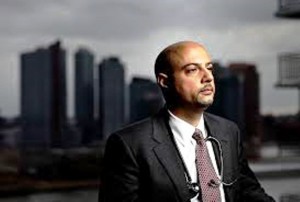
Sam Parnia MD has a highly sought after medical speciality: resurrection. His patients can be dead for several hours before they are restored to their former selves, with decades of life ahead of them.

Parnia is head of intensive care at the Stony Brook University Hospital in New York. If you’d had a cardiac arrest at Parnia’s hospital last year and undergone resuscitation, you would have had a 33% chance of being brought back from death. In an average American hospital, that figure would have fallen to 16% and (though the data is patchy) roughly the same, or less, if your heart were to have stopped beating in a British hospital.

By a conservative extrapolation, Parnia believes the relatively cheap and straightforward methods he uses to restore vital processes could save up to 40,000 American lives a year and maybe 10,000 British ones. Not surprisingly Parnia, who was trained in the UK and moved to the US in 2005, is frustrated that the medical establishment seems slow and reluctant to listen to these figures. He has written a book in the hope of spreading the word.

The Lazarus Effect is nothing short of an attempt to recast our understanding of death, based on Parnia’s intimate knowledge of the newly porous nature of the previously “undiscovered country from which no traveller returns”. His work in resuscitation has led him logically to wider questions of what constitutes being and not being. In particular, he asks what exactly happens, if you are lying dead before resuscitation, to your individual self and all its attendant character and memories – your “soul”, as he is not shy to call it – before it is eventually restored to you a few hours later?

When I meet Parnia, he is not long off the plane from New York after a night flight with his wife and baby daughter, and the particular revival he is craving is the miracle of strong coffee. He is both forthright and softly spoken, full of careful zeal for his findings. As I sit across the table from him, he can make even the most extraordinary claim seem calmly rational. “It is my belief,” he says, “that anyone who dies of a cause that is reversible should not really die any more. That is: every heart attack victim should no longer die. I have to be careful when I state that because people will say, ‘My husband has died recently and you are saying that need not have happened’. But the fact is heart attacks themselves are quite easily managed. If you can manage the process of death properly then you go in, take out the clot, put a stent in, the heart will function in most cases. And the same with infections, pneumonia or whatever. People who don’t respond to antibiotics in time, we could keep them there for a while longer [after they had died] until they did respond.”

Parnia’s belief is backed up by his experience at the margin of life and death in intensive care units for the past two decades – he did his training at Guy’s and St Thomas’ in London – and particularly in the past five years or so when most of the advances in resuscitation have occurred. Those advances – most notably the drastic cooling of the corpse to slow neuronal deterioration and the monitoring and maintenance of oxygen levels to the brain – have not yet become accepted possibilities in the medical profession. Parnia is on a mission to change that.

The one thing that is certain about all of our lives, he says, is that we will all eventually experience a cardiac arrest. All our hearts will stop beating. What happens in the minutes and hours after that will potentially be the most significant moments of our biography. At present, the likelihood is, however, that in those crucial moments we will find ourselves in the medical environment of the 1960s or 1970s.

The kind of CPR (cardiopulmonary resuscitation) that we are familiar with from medical dramas – the frenzied pumping of the chest – remains rooted, Parnia claims, in its serendipitous discovery in 1960. It remains a haphazard kind of procedure, often performed more in hope than anticipation. Partly, this is a question of personnel. Parnia is quietly maddened by the worldwide hospital habit, in the event of death, to send the most junior of doctors along “to have a go at CPR”. It is as if hospital staff have given up before they have started.

“Most doctors will do CPR for 20 minutes and then stop,” he says. “The decision to stop is completely arbitrary but it is based on an instinct that after that time brain damage is very likely and you don’t want to bring people back into a persistent vegetative state. But if you understand all the things that are going on in the brain in those minutes – as we now can – then you can minimise that possibility. There are numerous studies that show that if you implement all the various resuscitation steps together you not only get a doubling of your survival rates but the people who come back are not brain damaged.”

In Parnia’s ideal world, the way that people are resuscitated would first take in the knowledge that machines are much better at CPR than doctors. After that, he suggests, the next step is “to understand that you need to elevate the level of care”. The first thing is to cool down the body to best preserve the brain cells, which are by then in the process of apoptosis, or suicide.

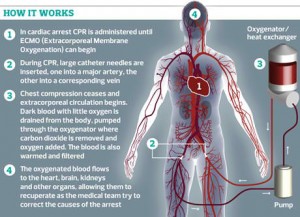
At the same time, it is necessary to keep up the level of oxygen in the blood. In Japan, this is already standard practice in emergency rooms. Using a technique called an ECMO, the blood of the deceased is siphoned out of the body, put through a membrane oxygenator and pumped round again. This buys the time needed to fix the underlying problem that caused the person to die in the first place. If the level of oxygen to the brain falls below 45% of normal the heart will not restart, Parnia’s research shows. Anything above that and there is a good chance.

Potentially, by this means, dead time can be extended to hours and there are still positive outcomes. “The longest I know of is a Japanese girl I mention in the book,” Parnia says. “She had been dead for more than three hours. And she was resuscitated for six hours. Afterwards, she returned to life perfectly fine and has, I have been told, recently had a baby.”

It was a truncated version of this process, at the London Chest Hospital, that allowed the Bolton footballer Fabrice Muamba to be restored to life after he collapsed on the pitch at White Hart Lane last year. Parnia watched the events unfold on TV and subsequently kept on reading that Muamba had been, for up to an hour, “dead” – but always in quotation marks. He laughs. “Journalists have invented a new term, ‘clinically dead’. I don’t know what that term means. But the fact is Muamba was dead. And it was not by a miracle he was brought back to life, it was by science.”

One of the stranger things you realise in reading Parnia’s book is the idea that we might be in thrall to historical perceptions of life and death and that these ultimate constants have lately become vaguer than most of us would allow. The other strand of Parnia’s research, in which he leads a team at Southampton University, is into what most people tend to call “near-death experiences” and what he calls “actual death experiences”. Parnia has talked to many people about what they recall experiencing while they were dead in his intensive care unit. About half claim to have clear recollections, many of which involve looking down on the surgical team at work on their body or the familiar image of a bright threshold or tunnel of light into which they were being drawn. Parnia has been collecting detailed accounts of these experiences for four years. I ask what conclusions he has drawn.

He suggests he is agnostic about the source of these subjective memories, as he is about questions of mind and matter. “When I first got interested in these mind/body questions, I was astonished to find that no one had even begun to put forward a theory about exactly how neurons in the brain can generate thoughts,” he says. “We always assume that all scientists believe the brain produces the mind, but in fact there are plenty who are not certain of that. Even prominent neuroscientists, such as Sir John Eccles, a Nobel prizewinner, believe that we are never going to understand mind through neuronal activity. All I can say is what I have observed from my work. It seems that when consciousness shuts down in death, psyche, or soul – by which I don’t mean ghosts, I mean your individual self – persists for a least those hours before you are resuscitated. From which we might justifiably begin to conclude that the brain is acting as an intermediary to manifest your idea of soul or self but it may not be the source or originator of it… I think that the evidence is beginning to suggest that we should keep open our minds to the possibility that memory, while obviously a scientific entity of some kind – I’m not saying it is magic or anything like that – is not neuronal.”

Does he have a religious faith?

“No,” he says, “and I don’t have any religious way into this. But what I do know is that every area of inquiry that used to be tackled by religion or philosophy is now tackled and explained by science. One of the last things to be looked at in this way is the question of what happens when we die. This science of resuscitation allows us to look at that for the first time.”

While those more esoteric studies go on, Parnia wants to ensure that more and more people are successfully returned from death to tell whatever tales they can. “I still have colleagues in ICU who say, ‘I don’t know why we are doing all this stuff’,” he says. “Not long ago, I went for a job interview in New York at a teaching hospital and I was told if a patient comes in and has a cardiac arrest and they end up in the cardiac care unit they will be cooled, but if they end up in the intensive care unit the doctor in charge doesn’t believe in it. He thinks it blocks his beds so he won’t do it. I don’t see this as negligence exactly because there is, as yet, no authority telling us this is the standard we should use. But surely there should be.” All of this, I say, must have had a powerful bearing on Parnia’s own sense of mortality. Is he comforted or made paranoid by his work?

He suggests that the experience of talking to people who have returned from dying serves only to enhance his curiosity about the process they have undergone, and which he has sometimes helped to reverse. Other than that, he says: “In ICU, I see people dying every day and each time it happens a part of you thinks, one day this will be me. There will be people huddling round my bed deciding whether or not to resuscitate and I know one thing for sure: I don’t want it just down to pot luck whether I end up brain damaged or even alive.”

Graphic-by-Pete-Guest.-001Staying alive: The ‘miracle’ machine

WHAT IS ECMO?

During cardiac arrest, blood cannot carry oxygen to the brain, causing brain cells to decay irreparably, making recovery uncertain. CPR, in which circulation is manually stimulated to delay brain damage, has long been considered the last chance for patients. With ECMO, however, those same patients can be brought back from the brink and kept alive while doctors work towards diagnosis and treatment, making CPR seem primitive by comparison. This hi-tech method of resuscitation is known as ECPR and could mark a revolution in medical practice if adopted by hospitals worldwide.

HOW DOES IT WORK?

An extracorporeal membrane oxygenation machine (ECMO) is an advanced life-support apparatus. Two catheter needles are inserted, one into a major vein and one into a major artery, allowing a synthetic pump to begin drawing blood out of the body, circulating it through the apparatus, before returning it to the bloodstream. The blood passes through a membrane oxygenator, in which oxygen is introduced and carbon dioxide removed, much like the exchange of gases that takes place in the lungs. Some ECMO machines also include a heat exchanger, which can cool or warm the blood according to the patient’s condition.

A dedicated team is required to place a patient on ECMO but, once that patient is stabilised, the machine can be supervised by specially trained nurses and can maintain stability for sustained periods. This allows the patient to live without a functioning cardiopulmonary system for days or even weeks, giving diseased organs a valuable holiday in which to recover.

WHEN IS IT USED?

Until recently, it has been used largely for severe lung failure in babies. In the UK, it is principally thought of as an intensive care treatment used in the ward, but more and more US hospitals are adding ECPR to their emergency treatment options. In an emergency, when a patient has shown no return of spontaneous circulation after conventional CPR, a doctor would decide whether the patient merits being attached to an ECMO machine, which must be carried out in a matter of minutes. Emergency ECMO is therefore administered as a last resort to patients who stand a good chance of full recovery.

In these conditions, it can be very effective and patients who have been medically dead for hours have been resuscitated successfully through ECMO, which can restart the heartbeat through steady pressure and blood flow. Even after full cardiac arrest, in situations where cell decay and brain damage have been avoided, ECMO has proved a lifesaver. There are four ECMO centres in the UK. Europe’s largest centre and the only one in the UK that treats adults is the Glenfield hospital in Leicester.

miracle

Top 10 Things You Can’t Prove But People Believe Anyway

ghostBy: Lara Webster / Source: The List Universe

Empirical proof helps us validate what we should and shouldn’t believe, but sometimes cold hard facts just aren’t available. Even when we don’t have solid proof, however, humans still tend to extend their sense of belief to certain phenomenon. From things we could never see with the human eye to life forms that have yet to be verified, here are the top 10 things we believe despite a lack of verifiable proof.

10. Aliens

While conspiracy theories and UFO sightings abound, we don’t have verifiable proof that other lifeforms exist in the space beyond our own planet. Still, many people firmly believe that there is life on other planets, or that life did exist at some point in the past. From video claims of inexplicable objects in the sky, to personal testimonials from people who say they’ve been taken into a spacecraft, we want to believe that there is more to life than what is on our own planet even if it has yet to be scientifically proven as fact.

9. Astrology

The notion of astrology is not a new one; people have been making major life decisions by the stars for centuries. Without any real proof that the way the planets and stars are aligned will actually shape a person, we believe that if we are born under a certain zodiac sign we are bound to a particular disposition and set of skills. Daily horoscopes and astrological charts have become a guiding tool for many people, who truly think that one’s birth date determines her fate and can help her make day-to-day decisions.

8. Cryptids

Cryptids are animals whose existence has never been proven by science, such as Bigfoot or the infamous West Virginia Mothman. Enough sightings and amateur photographs exist that we consider it possible that these creatures really do walk or swim the Earth with us, even though they don’t exist in museums and aren’t officially acknowledged. Until the Loch Ness monster or another cryptid is captured, they will continue to be merely mystical creatures of which no proof exists.

7. Ghosts

Anyone who claims to have seen a ghost might say that there is proof of spirit life, but skeptics would argue that any ghostly sighting can be explained away by lighting tricks or other logical reasons. At the end of the day, there may never be indisputable, tangible proof of ghosts. While ghost hunters have electronic tools meant to measure ghost activity, results are open to interpretation. Yet, we believe in ghostly encounters and phenomenon – that when things go bump in the night or move suddenly, a ghost can be the cause.

6. Psychic Mediums

Psychic mediums purport to talk to people who have died and gone to “the other side.” Mediums convey details that they supposedly hear from the deceased to loved ones who are still alive. Despite any way to really measure how psychics come by the information they doll out, we believe that they are someone seeing and hearing signs from dead people. While psychic mediums offer a less than 100% accuracy rate, the desire to speak to our dead family and friends is so great that we overlook their mistakes and grant them the benefit of the doubt.

5. Karma

Whether you call it karma, or just “what goes around comes around,” people have a common belief that the behavior you exhibit today somehow informs what happens to you down the road. With no more than anecdotal proof, we think that acting morally or fairly now will yield positive things for us in the future. Despite the simple fact that we can never prove that karma exists, it remains a principle that many people live by in the hopes that they can reap the benefits it promises.

4. Intuition

Call it a gut feeling, or intuition, but we believe that sometimes a sixth sense provides us silent guidance. Intuition can tell us when to distrust someone, end a marriage, avoid a certain street, or steer us in any number of directions. With seemingly no logical explanation, our intuition helps us make decisions with confidence and allows us feel like we are making a decision based on a trusted power that is bigger than ourselves. We give intuition credit for showing us which way to go when we hit a fork in the road.

3. Fate

The phrase “everything happens for a reason” is thrown around quite a bit, especially after something unfortunate happens. While we have no real reason to suspect that there is a sense of reason to life’s events, we tell ourselves that certain events – if not all of them – are fated to fall into place in precisely the way in which they do. The idea of destiny gives us comfort and helps us to pick ourselves back up after a disaster or hurtful life event.

2. Religious Texts

Regardless of one’s background, most of us believe in an organized religion of some sort. Religions are taught through texts, such as the Bible, which are thought to spell out exactly how a higher power wants humans to live. We believe stories about people who lived for hundreds of years, completed fantastic feats, and even managed to overcome mortality – because they are a part of a religious text. Though no proof exists that these writings are a true reflection any higher power, people do their best to abide by the rules and morals outlined within religious books.

1. God

Easily the biggest leap of faith that humans take is believing that a higher power, or God, exists and somehow sees and guides our life. From thinking that an inner prayer is heard, to the belief that we will come face to face with a higher power after death, we think that God is not only real but everywhere. By definition, God cannot be proven through empirical evidence, and yet the notion of a higher power is something that ties us to some of the earliest people and each other.