How To Find Your Lucky Numbers?

By: Tara Pierce / Source: Astro Star

Whether you’re a pro at poker, a connoisseur at craps or a rookie at roulette, you can improve your odds of winning if you know which numbers are in your favor. You may improve your luck quotient without studying heaps of “How To Win At…” books. The following simple system was used by the ancient Egyptians to prop up waning mental telepathy; and it doesn’t take long to learn. In these modern times, we can still use yesteryear’s secrets to augment our gambling techniques. And for those games that don’t require considerable skill to win, like the slot machines and Keno, maybe your lucky numbers will be just that for you — lucky. The best part is that you don’t have to be a computer wizard to figure it all out. Once you know your birthday number, you’ll never forget it because it is your number for life. And the benefits of a few minutes of math additions may get you to the pot of the gambling rainbow quicker than the other guy. Special! 93% of Lotto Winners Do This Before Buying the Ticket

Here’s How It Works

Add the month, day and year of your birthday together like this example: June 12, 1942. 1) June is the 6th month of the year. 2) Add compound numbers like the 12 day together (1+2) to get a single digit: 3. 3) Then add your year’s numbers 1+9+4+2 = 16. Reduce the 16 (1+6) to get a single digit: 7. 4) Then add your month (6), day (3), year (7) subtotals. You’ll get 16. Reduce again to a single digit (1+6) to get 7. 5) This person’s Life path and Lucky Number is 7. Always reduce to a single digit unless your compound number is an 11. You would then use the 11 instead of reducing to the 2. Alert! Secrets of Lucky People

How To Use Your Lucky Number

If you are a seven like the sample above,then go where the “seven” casinos are. Add their addresses to see what potential awaits you. 3921 Nobucks Street is a 6 place (3+9+2+1 = 15 = 6) All that glitters here is gold only for the guy who is born under a 6. To make matters worse for a 7, that address doesn’t even contain a seven. Keep searching until you find your lucky seven place. Add those addresses. When you’ve found a “seven” brick and mortar casino or online casino, let your creativity have free reign. Go to tables numbered seven. Slot machines have numbers; it takes only a few seconds to add up those numbers. Remember to reduce to a single digit. On Keno use multiples of seven; 49 is a good number for a seven because it’s seven times seven. If you can afford it, stay with your “seven” table or with your slot machine seven tries before you give up. You’ll obviously be moving around more if you happen to be a two. Use your lucky number for dates too. Can you think of a more auspicious time to have gambled than on July 7, 1991 at 7 a.m., if you’re a seven? Keep in mind that your number is good for you, better and luckier than any other digit could ever be over the long haul of a lifetime. That number has had an affinity with you from birth. Give it a chance to work for you. Have faith in its power. It’s the easiest and most natural way to have luck on your side Related Resources:


7 Secrets to Knowing Your Higher Self

higher selfBy: Asoka Selvarajah / Source: in5d.com

Each of us is connected with the Divine. The Higher Self within us far transcends the understanding of our conscious minds. This is the power that all the great geniuses and teachers of history have accessed. It is also the place of magic and miracle in our lives. Here are the seven key steps to contact it:

1. Belief & Expectation: Transform Your World View!

The first step is to BELIEVE that you have a Higher Self to establish communication with! Then EXPECT every day that this communication will improve as you focus diligently on inner growth. Without these two essential pre-..requisites, it is hard to achieve anything at all in life, even on the physical level. For inner growth, these two qualities are essential. So set a GOAL to achieve contact with the Higher Self, review that goal daily, and maintain your purpose with determination until success is yours.

We are brought up with a primarily materialistic world view that neglects the role of Spirit. To establish close contact with spiritual realms, we need to have our entire being – conscious and subconscious – congruent with our goal. In any major activity/goal, you have to establish the rules of the game and the way it is played. Contacting your Higher Self is the same. Therefore, seek out writings and teachers that expand your understanding of the universe as fundamentally being a realm of Consciousness and Mind.

2. Solitude & Meditation

Make regular time for yourself where you can be totally alone. A quiet place is preferable. Just sit quietly with no expectations. Do NOTHING. This may feel very uncomfortable and strange in the beginning. Persist. You give time and space for the inner voice to make itself heard. It will do so either during that quiet time, or else during the events of the day. A synchronistic event will occur; someone will tell you exactly what you need to hear; you will get a sudden flash of insight. All the great geniuses of history have found times of regular solitude and silence for themselves. You should too.

In meditation, you work to discipline your mind and silence the internal chatter that constantly fill it. You create a pure vessel for the Higher Self to fill. Following your breath is an excellent meditation discipline, as is concentrating upon a candle flame. Or visualize a golden ball of light in your Solar Plexus that fills your whole body with energy and healing. There are many practices that you can study and use.

3. Journal

Record your feelings, emotions, dreams and insights every day in a journal. This will help you to come into closer contact with your inner intuitive depths. You can ask the Higher Self questions here, and then later on record whatever insights/..answers you receive. If you do this regularly with belief and expectation, you WILL receive the answers you need.

4. Inner Dialogue

Conduct a regular inner dialogue with your Higher Self. For the next 40 days, decide to keep in contact throughout the day. Say to your Higher Self, “I know you are there and I want to get to know you and pay attention to you. Please begin to speak to me and guide my life.” Don’t worry if this dialogue is entirely one-way to begin with. Remember that you have been out of touch for decades. It takes a while to clear the cobwebs! Persist with this inner dialogue as if talking to a friend – chatting, asking questions, sharing your hopes – and begin to listen for answers. They will come.

5. Life Lessons

Look upon life as a Mystery School. Believe that the whole of your life – events, situations and people – has been structured PRECISELY in order to teach you exactly what you need to know right now. Approach life as if the whole of creation is conspiring to do you good! Whenever something happens in your life, for good or ill, ask yourself what the lesson is for you. Even unpleasant people/..situations have been deliberately placed there as a challenge to help you grow. As you begin to view life as a drama in which you are play the starring role, the role of the Higher Self will become increasingly evident in your life. Record your findings in your journal.

6. Dreams

Expect your Higher Self to speak to you in dreams. Before going to sleep, do some stretching and bending to relax your body completely. Ask your Higher Self a question and expect an answer. When you wake up, recall whatever you can of your dream and write it down in your journal. If you are not used to remembering dreams, this will take time and persistence. However, with patience, you will begin to recall your dreams AND receive answers from your Higher Self.

7. Mindfulness

Focus upon living more and more in the present, on the NOW. When you are eating, be aware that you are eating. When you walk, know that you are walking. The only real moment is now – the past is gone forever and the future has yet to be. Therefore, work to clear your mind of concerns, illusions and extrapolations… Clear the mental clutter from the mind and create space for the Higher Self to fill.

Patience Is The Catalyst To Progress!

Remember, you may have spent your entire life out of touch with Source. Therefore, it takes time to learn how to re-establish contact. Anything worth doing takes time and practice. Be vigilant and practice these seven steps every day, and you will receive the answers you need. Remember: The Higher Self WANTS to be in contact. In fact, to even speak of it as someone apart from you is contradictory.

The Higher Self IS you! The real you.

So get in touch with YOU!

Detox naturally with these 8 yoga poses

Source: MSN

There are hundreds of yoga poses, or asanas, that strengthen, detox and balance your body. Here are a few of those poses, linked together by your breath. Together, they’re called Sun Salutation A (Surya Namaskara).

These poses tone your inner organ ring (liver, pancreas, spleen and kidneys), stretch your low back and hamstrings, strengthen your abdominal muscles, develop upper body strength, and activate the energy that grounds you to the earth. Oh, and they all feel pretty incredible, too.

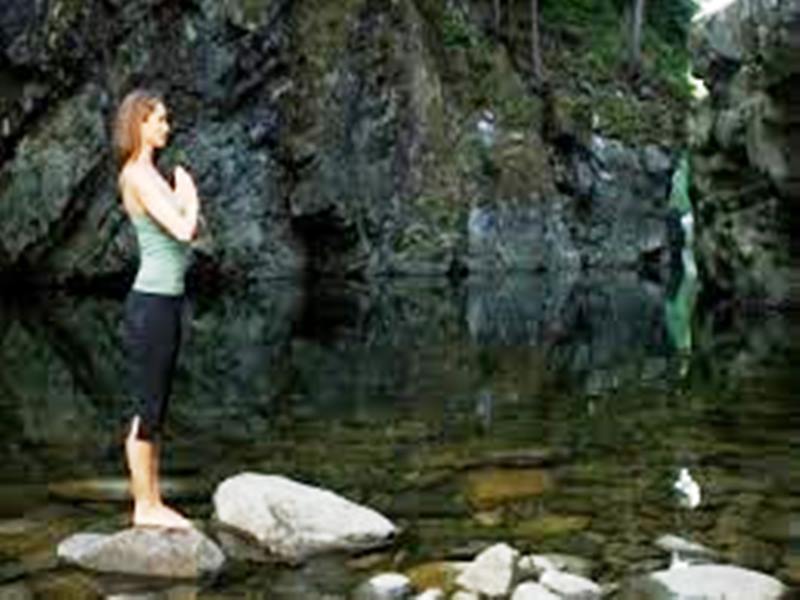
tadasanaMountain pose (Tadasana)

The benefit: Learning how to stand is the foundation of your practice and your relationship to the ground, to gravity and to your spine. In this pose, your spine lengthens while your torso, chest and shoulders open. Just as trees and plants send roots down into the earth and branches up to the sky, you will press your feet to the earth and rise tall.

How to do it: Begin by standing with your feet together. Press into all four corners of your feet. Lift your toes. Drive your legs and feet down into the earth. Lift your chest to lengthen your spine while rooting your lower body down. Find neutral pelvis by rocking it forward and backward, tucking your tailbone under and then sending your tailbone back.

Rock your pelvis back and forth to see if you can find a place right in the middle, a place that feels “just right,” where your pelvis is just floating. Pull the tops of your shoulders back and broaden your shoulder blades across your back. Allow your arms to hang by your sides, palms facing forward, in a gesture of receiving. Gaze forward. Stand like a mountain.

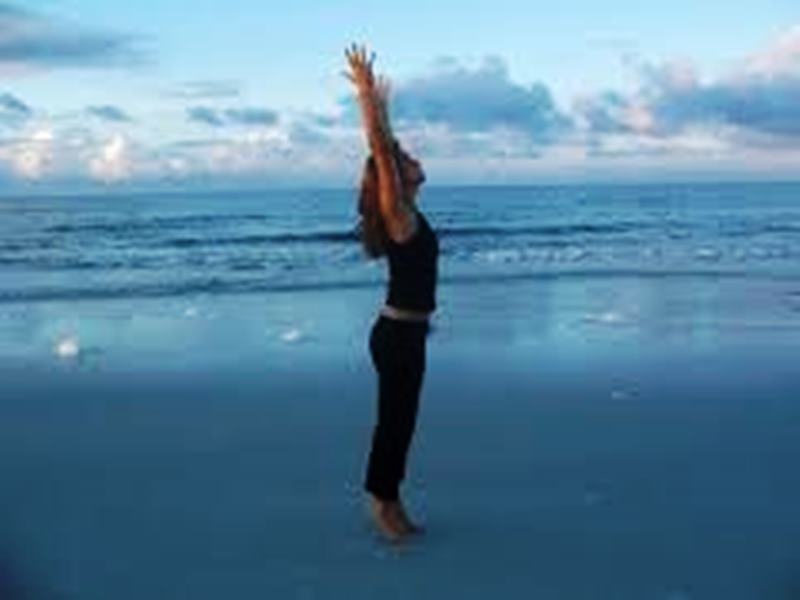
imagesUpward-facing hands pose (Urdhva Hastasana)

The benefit: This pose opens your torso, neck, chest and shoulders. With hands overhead, this pose relieves gravitational compression on your body.

How to do it: From mountain pose, inhale as you sweep your arms up and out to the sides, reaching overhead, shoulder-width apart. If comfortable, bring your palms together. Straighten your elbows if possible. Take your gaze upward.

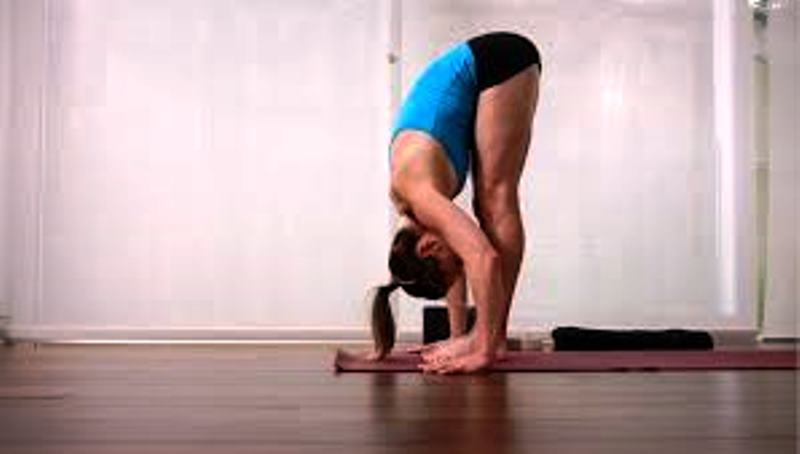
UttanasanaStanding forward fold (Uttanasana)

The benefit: Standing forward fold pose is a resting pose for your heart, because when you’re in it, your head is below your heart. Use the pose to stretch and relax your upper body. Like all inversions, it clears and balances your mind. If your hamstrings are tight or your lower back is weak, bend your knees softly.

How to do it: From Urdhva Hastasana, fold forward, hinging at the hips, bringing your palms to the ground. Press your chest toward your thighs and bring your chin toward your shins. Draw the crown of your head down toward the mat. Allow your neck to be long. If your palms don’t reach the mat, put a soft bend in your knees. Take this pose twice more, resting for two breaths in between.

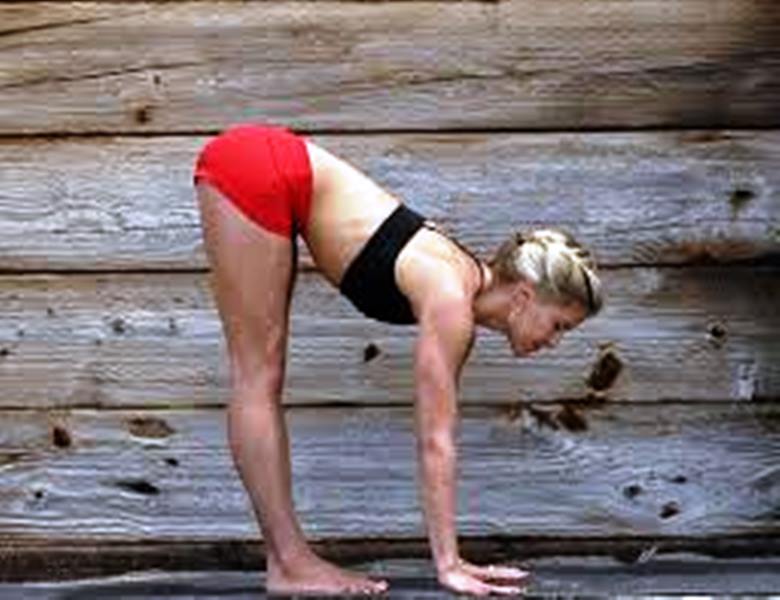
images (1)Half forward fold (Ardha Uttanasana)

The benefit: This pose stretches your hamstrings, elongates your spine and engages your abdominals.

How to do it: From standing forward fold, keep your fingertips on the mat. Inhale as you lift your torso halfway up, keeping your back flat and neck long, bending your knees if necessary. If your hamstrings are tight, you can also bring your palms to your shins. Bend your knees as much as you need in order to keep your back flat. Gaze at a spot on the floor 6 inches ahead of your toes.

Urdhva Mukha SvanasanaHigh push-up (Plank)

The benefit: This pose builds both upper and lower body strength while coordinating and integrating the entire musculoskeletal system. Plank pose strengthens your abdominals, chest, arms and legs.

How to do it: From half forward fold, exhale as you step back so that you’re at the top of a push-up. Stand on the balls of your feet. Stack your shoulders over your wrists, spread your shoulder blades apart and pull them down your back. Lift your kneecaps up to engage your quadriceps (thighs).

Draw your navel up to your spine and hollow out your belly. Set your gaze between your thumbs to lengthen your neck. If this pose places too much strain on your shoulders, wrists or core, lower your knees to the mat, keeping a straight line from your knees to the crown of your head.

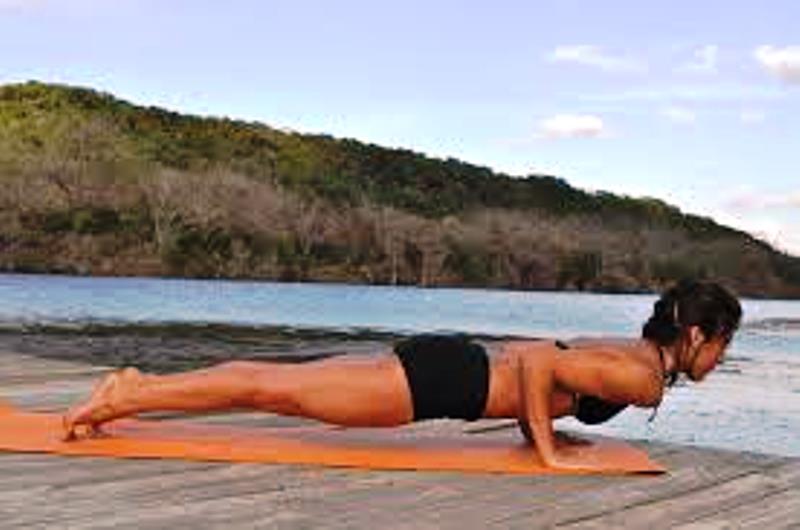
Chaturanga DandasanaLow push-up (Chaturanga Dandasana)

The benefit: Low push-up contracts your core abdominals, releases your low back and develops your upper body strength. This pose engages the entire musculature, activating and developing a connection between your core, your legs and feet, and your arms and hands. It can be challenging for yoga beginners; in that case, lower your knees to the mat for a modified low push-up.

How to do it: From high push-up, exhale and bend your elbows, drawing them backward close beside your ribs. As you lower your torso toward the floor, move your upper body forward and hover over the mat until your elbows are bent at 90 degrees. Draw your navel to your spine and hollow out your belly. Hug your elbows in by your sides and pull your shoulders away from your ears. Gaze forward.

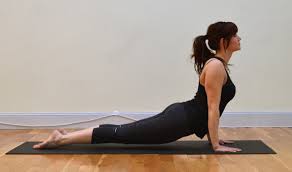
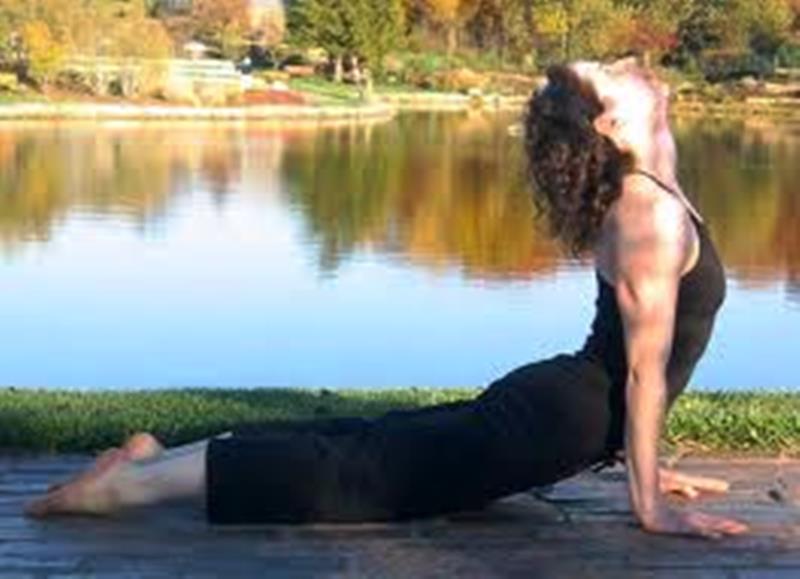
images (2)Upward-facing dog (Urdhva Mukha Svanasana)

The benefit: Upward-facing dog lengthens your spine and strengthens your back and arms, while expanding your entire front torso.

How to do it: From low push-up, inhale, press down on your hands, and scoop your chest forward. As you lift up your torso, roll over the tops of your toes and move your torso forward. Press the tops of your feet down into the mat. Engage your quadriceps to lift the tops of your thighs off the mat. Pull your shoulders down your back, squeezing them together, as you press your chest forward and up. Gaze forward so that your neck is in line with your spine.

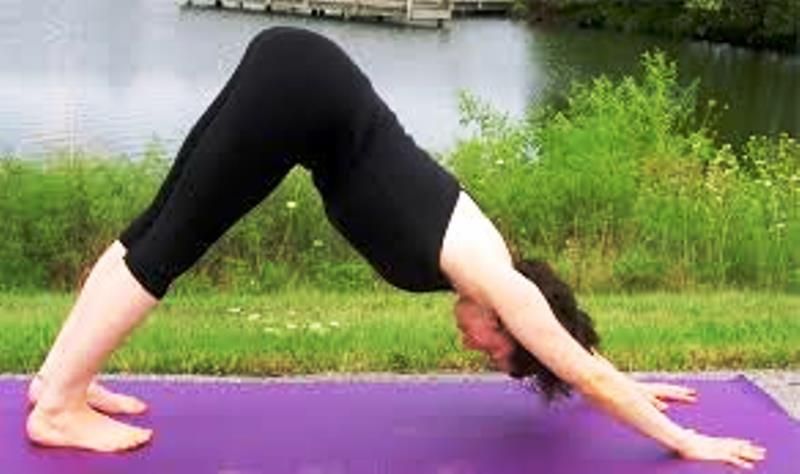
images (3)Downward-facing dog (Adho Mukha Svanasana)

The benefit: Downward-facing dog is one of the most important poses in yoga, connecting your body, mind and spirit. It lengthens your spine, extends your legs, strengthens your ankles and develops your upper body and leg strength, while easing stiffness in your neck, shoulders and wrists. Holding this pose reduces fatigue, restores energy and calms your nervous system, creating grounding energy in both your hands and feet simultaneously.

How to do it: From upward-facing dog, exhale, curl your toes and lift your sits bones high to the sky, creating an inverted V with your body. Pull your shoulders away from your ears, then spread them out, and roll them down your back. Press your palms flat and spread your fingers wide. If your wrists begin to ache, press the knuckles of your index fingers down to balance your weight and protect your wrists.

Contract your quadriceps to redistribute your weight onto your legs and off of your wrists. Draw your navel up and press it back to your spine. Hollow out your belly. Take your gaze up to your thighs or navel, if you can. Remain in downward-facing dog for five complete breaths, inhaling and exhaling with long, fluid breaths.

Step, jump or float forward to complete sun salutation A

The benefit: This motion links one pose to another and brings your feet back to the top of your mat.

How to do it: After five breaths in downward-facing dog, inhale and exhale one more time. As you exhale, press all the air out, lift your heels, bend your knees and press your thighbones back. As you inhale, look at your hands and, using your abdominal muscles, shift your weight onto your hands and spring your feet forward to the top of your mat.

If this doesn’t work for you, walk your feet to the top of the mat for standing forward fold. Exhale. From standing forward fold, inhale. Lift halfway up with a straight back to half forward fold. Exhale and fold forward, hinging at your hips, to arrive in standing forward fold with fingertips pressing into the mat.

From here, use your abdominals to lift and lengthen your torso as you sweep to standing on an inhalation, extending your arms overhead to upward-facing hands pose. Bring your palms together. From upward-facing hands pose, exhale and bring your arms down by your sides for mountain pose. Relax your shoulders down your back and away from your ears. Soften your gaze. Repeat Sun Salutation A two to five times.


Meditation – finding that sacred place

meditationSource: Kooma

For many, meditation is simply a way to relax; a way to clear the mind of stresses and strains and focus on yourself. There are even health benefits associated with the practice. Meditation has been found to lower blood pressure, improve levels of concentration and is even recommended as a way to help combat depression.

However, for others, meditation serves a much deeper purpose. Many practice it in the hope that they will reach a state of enlightenment or achieve the Buddhist ideal of Nirvana. If you are looking to facilitate your spiritual awakening then it’s worth knowing how others have achieved this state. In order to do this, we need to look at the origins of meditation and the concept of Nirvana.

The story of the Buddha

Meditation has many forms and has been practiced by holy men and spiritual leaders for over a thousand years. Where the practice originated is the subject of some debate. The Hindus lay claim to it, as do the Chinese and even the Native American Indians used meditative forms in order to put themselves in touch with the hidden powers of Nature. However, the idea that meditation can be used to achieve a state of complete spiritual grace must lie at the hands of Siddhartha Gautama – otherwise known as The Buddha.

Although Siddhartha practiced meditation as part of his desire to achieve spiritual insight. According to the story, it wasn’t until he fell into quiet contemplation under a tree that he managed to achieve complete enlightenment. Although he had absorbed the teachings of countless wise men and practiced meditation on a daily basis, it wasn’t until this moment that he took the final step to Nirvana.

However, his spiritual awakening was so profound that he was unable to fully put it into words. Nor was he able to explain how this state is achievable for everyone else. What he was able to say is that Nirvana and enlightenment are achievable, through following a set of strictures: the Four Noble Truths and the Noble Eightfold Path.

The Four Noble Truths

The Four Noble Truths are a way of beginning to understand what life is, what role we play in it and our responsibilities to those around us. They are also things to be mindful of in meditation, as they guide our intent and remind us what it is we are truly trying to achieve. The Four Noble Truths teach that:

● Life is suffering.

● The suffering is caused by our ignorance of the true nature of the universe.

● The suffering can only be ended by overcoming this ignorance and any attachment to earthly things.

● Ignorance and attachment can be overcome by following the strictures of the Noble Eightfold Path.

The Noble Eightfold Path is a code of living that embraces all aspects of our existence. While they are incredibly vague, each Buddhist is free to interpret them in the way that makes them most pertinent; we are free to create our own path to Nirvana. All it really requires is the understanding that we understand our relationship with the natural world and are prepared to embrace the consequences of being conscious and mortal beings. The eight strictures of the Noble Eightfold Path are:

1) Right views

2) Right intention

3) Right speech

4) Right action

5) Right livelihood

6) Right effort

7) Right-mindedness

8) Right contemplation

The importance of meditation to achieving either Nirvana or enlightenment cannot be underestimated and it involves both the Four Noble Truths and the Noble Eightfold Path. In the eyes of the Buddha, it is us who cause the suffering we experience, and that suffering can be tracked down to the Ego.

The Ego is the hub of all our doubts, fears, and flaws. These characteristics are the obstacles that are set in our way to fully understanding our purest reasons for being. Meditation is a way of learning to silence the babbling inside our heads, and to mute the ramblings of the Ego. Until our minds are clear, they will remain in a state of psychic frenzy, keeping our true natures obscured from us.

Creating a path to enlightenment

However, it’s important to discern between clearing the mind and emptying it. Nirvana and enlightenment are not trance-like states; they are lucid and aware but allow us to exist on a different mental plane whilst still functioning on the physical one. In order to achieve this clarity, meditation must follow the Four Noble Truths and the Noble Eightfold Path. Everything about your meditation must be considered, from your intent to your posture. You must put in the right effort and undertake the right contemplation.

However, given that the strictures of this sort of meditation are slightly nebulous, it means that you are given the freedom to create a form of meditation that is pertinent to you and you alone. Unless you are meditating under the eyes of a teacher, you are free to create your own path to enlightenment.

As the Buddha discovered, the path to enlightenment isn’t one that is guaranteed to take you where you want to go. Meditation isn’t a light-switch that you turn on and suddenly discover you’re spirit is awakened. Instead, it should be seen as part of an ongoing process. Through meditation you are creating the right environment within which enlightenment and Nirvana can be achieved, but you cannot decide or determine when it’s going to happen. Meditating towards the ultimate spiritual state isn’t just a thing you do when you feel like it; it is more a lifestyle choice.

Buddha himself had undertaken a lifetime of work and toil in his attempts to spiritually evolve, but it was only when the time was right for him and when he had laid down all the foundations that enlightenment took place. Reflecting on this, Buddha said that “enlightenment just happens; it is acausal. One can do all sorts of sadhanas but, ultimately, Spring comes when it comes; there is nothing you can do to bring it earlier. The flowers will bloom when they bloom; all they need is the natural conditions.”