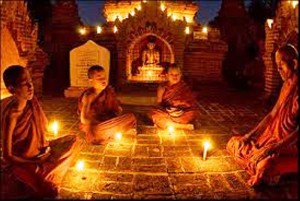
3 Buddhist Beliefs That Will Rock Your World (And Make You Much Happier!)

BuddhistBy: Megan Bruneau / Source: Mind Body Green

You don’t have to practice yoga or follow an Ayurvedic diet to benefit from Buddhist ideas (but if you do, more power to you).

So whether or not you think about balancing your dosha, here are three powerful elements of Buddhist philosophy, “The Noble Truths,” and how you can incorporate them into every day.

They might just change your life…

1. Dukkha: Life is painful and causes suffering.

Many people might say that Buddhism is pessimistic or negative. This is a common result of learning that one of the Noble Truths is translated as “Life is suffering.”

But there’s more to this statement. It’s not just telling us, “Life is tough, so deal with it.” So what is it telling us?

We actually can create more suffering in our lives by trying to avoid or suppress difficult emotions.

Yes, our lives are inevitably punctuated with various unpleasant feelings: loss, sadness, fatigue, boredom, anxiety appear and reappear during our lives.

But attaching or clinging to particular expectations, material items, and states of being is often a cause for acute frustration, disappointment, and other forms of pain.

So rather than fear our suffering or seek an ultimate resolution to it (and become frustrated by our lack of finding one), we can learn simply to recognize our suffering.

How we can use this belief every day: Try not to buy into the idea that you’re broken. Expect that death, aging, sickness, suffering, and loss are part of life.

Practice acceptance in the face of strife. Stop attaching to the idea that life should be easy and pain free, both emotionally and physically. This is a misconception made popular by the fashion, beauty, and pharmaceutical industries.

Illness, heartbreak, loss, disappointment, and frustration are parts of life that can be mitigated by practicing “non-attachment.” Try to embrace imperfection, to let go of this belief that life should be a certain way. Open your heart to uncertainty.

2. Anitya: Life is in constant flux.

Anitya or “impermanence” means that life as we know it is in constant flux. We can never access the moment that just passed, nor can we ever replicate it.

As each day passes, our cells are different, our thoughts develop, the temperature and air quality shifts. Everything around us is different. Always.

When we are feeling especially uncomfortable, the concept of impermanence can be, paradoxically, comforting. In other words: if nothing is permanent, we know our pain will pass.

But when we are experiencing joy, the idea of impermanence can be incredibly fear-inducing.

If we accept the idea of impermanence at face-value, it can be incredibly liberating. In the West, about 100 years after the Buddha expressed this idea, Greek philosopher Heraclitus mirrored the belief when he famously said, “You can never step in the same river twice.” All we have is the present moment.

How we can use it in our everyday lives: Celebrate the idea of change. Accept that everything is constantly changing. It’s kind of amazing, when you just think about it!

And even when the idea of impermanence might feel scary, it helps us appreciate everything we are experiencing in the present: our relationships, body, mood, health, the weather, our favorite shoes, our jobs, our youth, our minds.

So let’s savor those moments we do enjoy and know that the ones we don’t enjoy will pass.

3. Anatma: The self is always changing.

When I ask clients what they want to get out of therapy, they commonly answer, “I want to find myself.” Our culture has led us to believe there’s a concrete, constant “self” tucked away somewhere in us.

Is it between our heart and liver? Or somewhere unknown in our brain? Who knows!

Buddhism, however, assumes there is no fixed, stable “self.” In line with Anitya (impermanence), our cells, memories, thoughts, and personal narratives — all of the “matter” that ultimately comprises our identities — change over time.

Sure, we all have personalities (though they can change over time). We have names, and jobs, and other titles that we use to identify ourselves, to feel a sense of “self.”

But the idea of a constant self is yet another story our culture has told us. It is a story we can change, and thereby accept the idea that we ourselves can change — at any time, in any place.

As Thich Nhat Hanh says, “Thanks to impermanence, anything is possible.”

How we can use it in our everyday life: Instead of focusing on “finding ourselves,” we ought to focus on creating the self we wish to be at every moment.

It’s possible for us to be, and feel, different today than we were and felt yesterday. Being depressed today doesn’t mean we’ll be depressed forever. We can forgive others. We can forgive ourselves.

Once we let go of our attachment to the idea of the constant “self,” we can rest more comfortably with the constant change present in all of life. In each new moment, we ourselves are new.

 

Want To Find Your Dharma? Ask Yourself These 7 Questions

dharmaBy: David G. Arenson / Source: Mind Body Green

The Buddhist concept of Dharma has a central philosophy that all is whole and complete as it is. There is no accident in the entire universe.

Even your reading this right now is not accidental, nor my writing it. We are together in this grand interplay of cosmic elements.

Most of the daily challenges we experience as human beings originate from a lack of understanding. Dharma is the way out of this.

The way to cultivate refinement of the mind and uplift the human experience from ignorance and suffering, is to practice Dharma.

So what is this cryptic and mysterious notion of Dharma and is there a way to decode it for modern consumption?

Dharma is a broad concept with many understandings and definitions, very much like the term coined by Chinese philosophy as Tao.

Its translation as “the path” or “the way”, Tao and Dharma support the natural order of the universe and those who are in harmony with it.

Dharma could also be described as the nature of “what is” and in Buddhism, refers to the practice of following the Buddha’s teachings. The diligent observance and practice of these teachings, is seen as the way to enlightenment.

One could argue that Dharma is a truth, a teaching, a practice and enlightenment itself.

Living in Dharma means living ones’ true purpose and personality, and expressing it in the world. By living quietly in fear, limitation, or otherwise, we are denying the world our one-of-a-kind gifts.

Living from the ego denies the full expression of our talents for the benefit of others. The purpose of Dharma is to allow the everyone in the world to evolve to their full potential.

“We know we are in Dharma when we cannot think of anything else we would rather be doing with our life.” —David Simon

How does one relate to the seemingly mystical and intangible elements to finding one’s Dharma?

For the whole symphony of the universe to vibrate at its most refined and poetic, it requires all individual instruments (that’s us!) to play their part. Thus, one thing is essential for the greater good — each person must follow their authentic path.

If every person sang their song, the symphony would be sublime, whole and complete.

I am not here by mistake. And neither are you! I am serving the whole, as are you. The Dharma needs all instruments to express themselves.

And then the whole universe supports us when we act according to our true nature, our calling and our purpose — our whole reason for being.

Living a meaningful life requires that we live in Dharma, in service of the whole of creation. Dharma is an active opening, a mission, a doorway, a purpose, a destiny, but also a passive process of surrender.

So how do you find YOUR Dharma? Here are seven questions to meditate on:

  1. Do you have any idea what your Dharma is?
  2. Have you found it yet?
  3. Where have you looked?
  4. How would you live differently if you knew your days were numbered?
  5. Which people do you admire most and why?
  6. What are your fondest memories?
  7. What were you doing when you recall having the most fun?

“You are born with a character, it is given, a gift as the old stories say, from the guardians upon your birth.” —James Hillman

The Five Pillars of Spiritual Mastery

feature_image_template36-620x400Source: Conscious Living News

Spiritual Mastery is defined as the perfection of the spiritual process and a complete understanding as to the nature of reality.

The benefits of Spiritual Mastery are extensive but include the ability to direct one’s destiny, choose one’s future higher-dimensional incarnations, transcend death, perceive the astral and trans-astral realms and perceive all of the non-physical and non-conceptual aspects of the Universe and Reality.

Compounded onto those benefits – one can also achieve Life Mastery in the 3D world (health, abundance, well-being, perfection of the use of energy and having a strong immunity to karma).

It is an elusive state as the vibratory bar for Spiritual Mastery is high – yet with an understanding and application of five main pillars – achieving this state in this life-time (and thus becoming a non-returner to 3D) is certainly possible.

Added to the elusiveness of the state is the fact that the state of Spiritual Mastery cannot be perceived directly from outside of it – and thus Spiritual Perfection remains vibrationally invisible until you are ready to understand directly.

Thus – any teacher (myself included) can only provide sets of tools and road-maps rather than wave a wand and grant you instant Universal Enlightenment. The path must be walked in order to transcend the path and attain an understanding of Truth!

So what are the five main pillars to reflect upon and create if one is serious about attaining Spiritual Mastery?

1. Truth

To attain a state of Spiritual Mastery (and remain there long enough to be able to make use of the state) – one must be committed to the path of truth. All lies cause confusion and distract one from the true path.

Lies, deceptions, trickery and all forms of cheating create karmic effects that dampen one’s vibration and keeps one trapped in a state of separation from Source / Ultimate Truth.

For the Universe to be completely open with you – you must be open with it – lies create barriers and resistances to true intimacy with the Universe.

Spiritual Truth cannot be perceived from any state not aligned to truth – and thus Spiritual Mastery is the product of a transmutation and renunciation of all lies!

2. Impeccability (Ethical Purity)

One of the main reasons why Spiritual Mastery is so hard to attain or to understand in the Western world is because of the unpopularity of being ethical.

Many people cheat, lie, steal, delude themselves or others, engage in control dramas and violate the basic spiritual laws and principles that make a strong relationship to Source possible.

Examples include taking or abusing the sanctity of life, unethical livelihood, sexual misconduct, theft, control (violation of free-will),a lack of respect for the path and a whole host of other ethical issues.

Without the ethical purity in place comprehending high-level spiritual understanding is impossible (there are Universal safeguards in place to prevent people blowing up stars and tearing holes in the Universe or damaging the purity of the Higher Planes – things that would happen if these safeguards were not present!)

Without ethics – whatever one thinks one knows may be false and in some cases one can become subservient to the energies of the Lower Astral – a phenomenon most notable in light-worker channellers who have not yet transcended control dramas.

In my experience of the light-worker community – beneath a superficial veneer of love and light lies a dark world of criminal behaviour, corruption, cheating, lying and a large array of other unresolved control dramas which tragically ends in victim-hood, sickness, misfortune, suffering and death – the end result of ignoring ethics.

The worst enemies of spiritual enlightenment are lying and cheating – both of which will cost you in energy terms many more times the cost of playing fair and true.

For as long as you have the tendency to lie, cheat or steal – spiritual understanding will be impossible to attain. When you cheat with intent – the karmic effect is amplified. Whatever benefit you may believe you obtained through deception and cheating – will quickly be outweighed by the subsequent depletion of energy.

What’s worse – in that depleted state – other people can then cheat you (what goes around comes around) and push you further down into the karmic web. Trying for a short-cut by cheating will always find you walking the hard and long way around.

Spiritual Mastery

The one thing that any spiritual teacher cannot teach you is how to live a life of integrity. Either one has it or one does not. It is not something one can learn overnight.

Only the experience of life can teach you about the importance of integrity. Without it – spiritual information, understanding or knowledge is useless – for it is like making a daily visit to the well with a gaping hole in the bottom of the bucket.

Nothing can be retained, integrated or made use of. This is why the world is hungry for spirituality and is not satiated – because there are a host of ethics and integrity issues in the way making retention impossible.

3. Bodily Purity

The body is the temple (the abode) of the Higher Self/Spirit/Atman. Keeping a strong relationship to Source requires an extreme level of vibrational purity and freedom from harmful toxins found in almost all foods and drinks on the planet.

The vices of modern day humanity (alcohol and tobacco) are the very things that ruin ones physical temple, destroying one’s light body and creating a further separation from Spiritual Truth.

Eating toxic food consumes vast resources of one’s life-force that could otherwise be directed to the attainment of spiritual understanding!

4. Abundance

Many people struggle with this one primarily because of a separation between the left and right hempispheres of the brain – leading one to polarize spirituality and abundance as mutually exclusive opposites.

Poverty then naturally ensues and one spends many years of one’s life working hard for little abundance instead of spending time doing spiritual practice!

Being spiritual and monetarily abundant simultaneously is a matter of transcending dualistic consciousness that attaches to the either/or mindset.

Having money with no spiritual understanding gives the experience of basic materialism and existence on Earth with no spiritual perspective – being separated from the inner.

Being spiritual and having no money keeps one trapped in a space of being powerless to do or create anything in the outer. Neither are balanced spiritual states and keep one trapped in an either/or and thus stuck in the illusion that one desires to exit.

I was once asked why I promote being abundant as a Spiritual Master. The answer is the matter of time.

Spiritual Mastery takes much effort and time – thus you will need to work less. You will need all of the time you can muster up to perfect the spiritual process and death can come to call at any moment.

Abundance can buy you more time which is the most valuable thing you can buy for your path.

Without plenty of abundance, you will be bound to the wheel of time through doing hard and low paid work – this will weaken your energy and destroy your body long before you are able to perfect a state of Spiritual Mastery.

5. Free Will

Without an understanding of free-will and an application of that understanding in one’s daily life – Spiritual Mastery will remain nothing more than a distant concept and pursuing it may not be in your best interests.

Free Will gives all beings the choice to determine their own path. Interference with free-will is control and incurs unfavourable karmas.

The energy of Source cannot be controlled or manipulated and this explains why holding onto control issues always causes frustration, conflict, power struggles, suffering and further separation from Source.

Without a respect for free-will there is no respect for the sovereignty and uniqueness of all sentient life. When respect for life is absent – one gravitates toward the opposite – death and the associated loss of awareness.

Death affirming actions, choices and beliefs deepen one’s entrapment to the reincarnation cycle.

Once all the five pillars are in place and one is grounded with pure intent – the pursuit of high-level spiritual understanding is worthwhile, fruitful and rewarding.

One will have the energy and vibration that will enable one to discern spiritual truth and make fast progress toward completing all of one’s lessons on Earth.

Meet Niki: Learn How She Manifested 1,000,000 Rands

Source: Living with the Law of Attraction

In this wildly compelling 4-minute video you’ll hear:

  • The exact process Niki Marshall used to manifest the million… 
  • The ‘unique twist’ she added to her affirmations that added so much power!
  • And so much more…

 banner